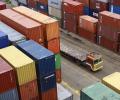
India and the UK will sign a free trade agreement on Thursday in London that will allow export of labour-intensive products such as leather, footwear and clothing at concessional rates, while making imports of whisky and cars from Britain cheaper. The pact also helps double trade between the two economies to $120 billion by 2030.

Russian President Vladimir Putin will make a two-day visit to India from December 4 to hold annual summit talks with Prime Minister Narendra Modi that is expected to produce a plethora of significant outcomes, including in the defence sphere, to further solidify the bilateral strategic ties.

The ruling is expected to have wide-ranging consequences for global trade, businesses, consumers, inflation trends and household finances across the country.

Greer said that India has taken down some digital services taxes and is moving tariffs down.

European Commission President Ursula von der Leyen says India and the EU are close to a 'historic trade agreement' that could create a market of two billion people and account for almost a quarter of the global GDP.

Exporters of gems and jewellery have said the free-trade agreement (FTA) has brought relief to their sector because this opens up the world's second-largest market and brings them on a par with China and Thailand, which face zero tariffs on shipments to Europe.
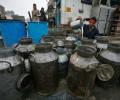
India has fully protected its sensitive sectors like dairy, rice, wheat, pulses, tea, genetically modified (GM) goods, and coffee by not granting any import duty concessions to the European Union (EU) under the bilateral free trade agreement, according to the Commerce Ministry.

India has wrapped up its operation at a strategic air base in Tajikistan's Ayni following the lapse of a bilateral agreement, people familiar with the matter said this week.

Commerce and Industry Minister Piyush Goyal on Sunday said Indian goods will have a competitive advantage in US markets compared to products from China and other competitor countries, which face higher levies, following the reduction in reciprocal tariffs to 18 per cent.

European wines are set to enter the Indian market at lower prices under the bilateral free trade agreement as India will provide import duty concessions under the pact, an official said. Under the pact, the duty on EU wines would fall from 150 per cent to 20 per cent (for expensive ones).

The turning point came with the appointment of Sergio Gor as the US ambassador to India.

'The BNP's election manifesto lists grievances against India, mirroring the attitude of past BNP governments.' 'Political parties have been careful not to say bad things about China.'

India will now face a lower reciprocal tariff of 10 per cent, down from 25 per cent, after US President Donald Trump announced a new global levy on items imported into America in the wake of the Supreme Court verdict against his sweeping duties on several nations.

Talks on the proposed trade deal between India and the United States will resume after the year-end holidays, coinciding with Sergio Gor -- a close aide of American President Donald Trump -- taking charge as the US Ambassador to India in early January, according to a person privy to the development.

The India-US ties witnessed a major downturn after President Trump slapped a whopping 50 per cent tariff on Indian goods, including a 25 per cent punitive levy over Russian oil purchases.
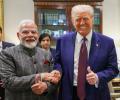
Trump announced that India and the US agreed to a trade deal under which Washington will charge a reduced reciprocal tariff on Delhi, lowering it from 25 per cent to 18 per cent.

India and Israel have elevated their relationship to a special strategic partnership, focusing on enhanced cooperation in trade, technology, and defense, while also addressing regional peace initiatives.

India and the European Union (EU) on Tuesday announced the conclusion and finalisation of negotiations for the proposed free trade agreement (FTA).

Following a Supreme Court setback, Donald Trump has announced an increase in global tariffs from 10% to 15%, impacting international trade relations and raising concerns about economic repercussions.

China and Pakistan concluded their strategic dialogue, reiterating their opposition to unilateral actions in South Asia and discussing Kashmir, Afghanistan, and trilateral cooperation.

Prime Minister Narendra Modi addressed the Israeli Parliament, reaffirming India's support for Israel in the face of terrorism and expressing support for the Gaza peace initiative.

Over the years, India-EU ties have grown, and covered trade, investment, climate change, science and technology, space, digital, mobility, and connectivity.

Equity benchmark indices Sensex and Nifty ended higher in highly volatile trade on Tuesday, buoyed by heavy buying in bank and metal stocks, a firm trend in global markets and optimism over India-EU FTA. The 30-share BSE Sensex climbed 319.78 points, or 0.39 per cent, to settle at 81,857.48.

India and Canada are negotiating a long-term uranium supply agreement worth $2.8 billion. They are also exploring expanded civil nuclear cooperation after the passage of the SHANTI Bill.

India and France have elevated their relationship to a 'special global strategic partnership,' with increased cooperation in defense, trade, and technology. The leaders also inaugurated a helicopter assembly line in Karnataka.

Prime Minister Narendra Modi on Tuesday announced the signing of the India-EU Free Trade Agreement (FTA), saying it accounts for 25 per cent of global GDP and one-third of global trade.
Textiles, pharmaceuticals, chemicals, engineering goods, gems and jewellery exports will receive a boost from the free trade agreement between India and the 27-nation European Union, according to exporters.

New Zealand Prime Minister Christopher Luxon on Monday said the negotiations for a free trade agreement with India have been concluded.

Indian captain Suryakumar Yadav says the team is focused on preparing for their T20 World Cup clash with Pakistan despite concerns about potential rain disruptions.
Prime Minister Narendra Modi will travel to China to attend the Shanghai Cooperation Organisation (SCO) summit, marking his first visit in over seven years. The visit signals a potential improvement in India-China relations after recent tensions.

The proposed trade deal with the 27-nation European Union (EU) is expected to provide zero-duty access to the $95 billion European market for Indian textile and apparel manufacturers. Currently, India's share of the European market is just 6 per cent, or $5.5 billion.

The agreement was to disengage from remaining standoff sites along the Line of Actual Control (LAC), two days before a meeting between Chinese President Xi Jinping and Prime Minister Narendra Modi on the sidelines of the BRICS Summit.

'After the Galwan clash, the rules of engagement changed with the army commanders allowed to use any means at their disposal as they deem fit for tactical operations.'

India and the European Union are set to announce on January 27 the conclusion of negotiations and finalisation of a free trade agreement, which is aimed at boosting economic ties between the two regions amid disruptions in global trade due to US tariffs, an official said.

The European Union (EU) has suspended export benefits to sectors such as textiles and plastics under a preferential scheme for India and two other countries from January 1, a move that will impact the country's shipment to the 27-nation bloc. The development is important as the two sides are likely to announce the closure of negotiations for a free tarde agreement (FTA) on January 27.

Israeli PM Benjamin Netanyahu has affirmed that the United States and his administration have achieved nearly total dominance over Iranian airspace following a series of coordinated military strikes.

Trump's outburst comes amid escalating tensions between the US and its northern neighbour, following recent remarks by Canadian Prime Minister Mark Carney at the World Economic Forum (WEF) in Davos.

US Treasury Secretary Scott Bessent indicated a potential pathway to remove tariffs imposed on India for purchasing Russian oil, citing a significant decrease in such purchases. He also criticized Europe's approach and accused India of profiting from discounted Russian oil.

India and the US have agreed to a trade deal that will see Washington reduce reciprocal tariffs on Indian goods from 25% to 18%, according to US President Donald Trump. The deal also includes commitments from India to reduce tariffs and non-tariff barriers against the US and to increase purchases of American products.

'Uncertainty level A in the morning, uncertainty level B in the afternoon. If I answer about tariff rates now, I'll be outdated by the evening.'
